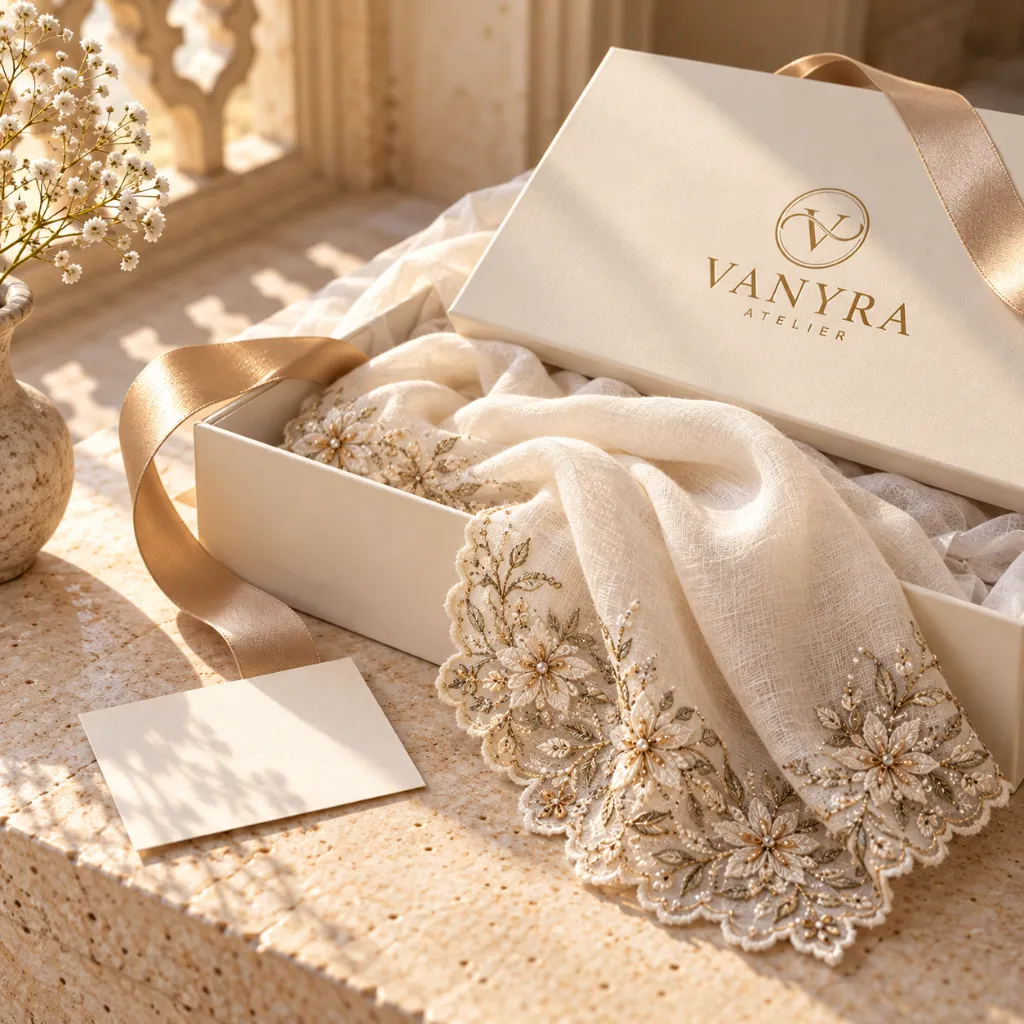
Inside the Atelier: A Weaver's Hands
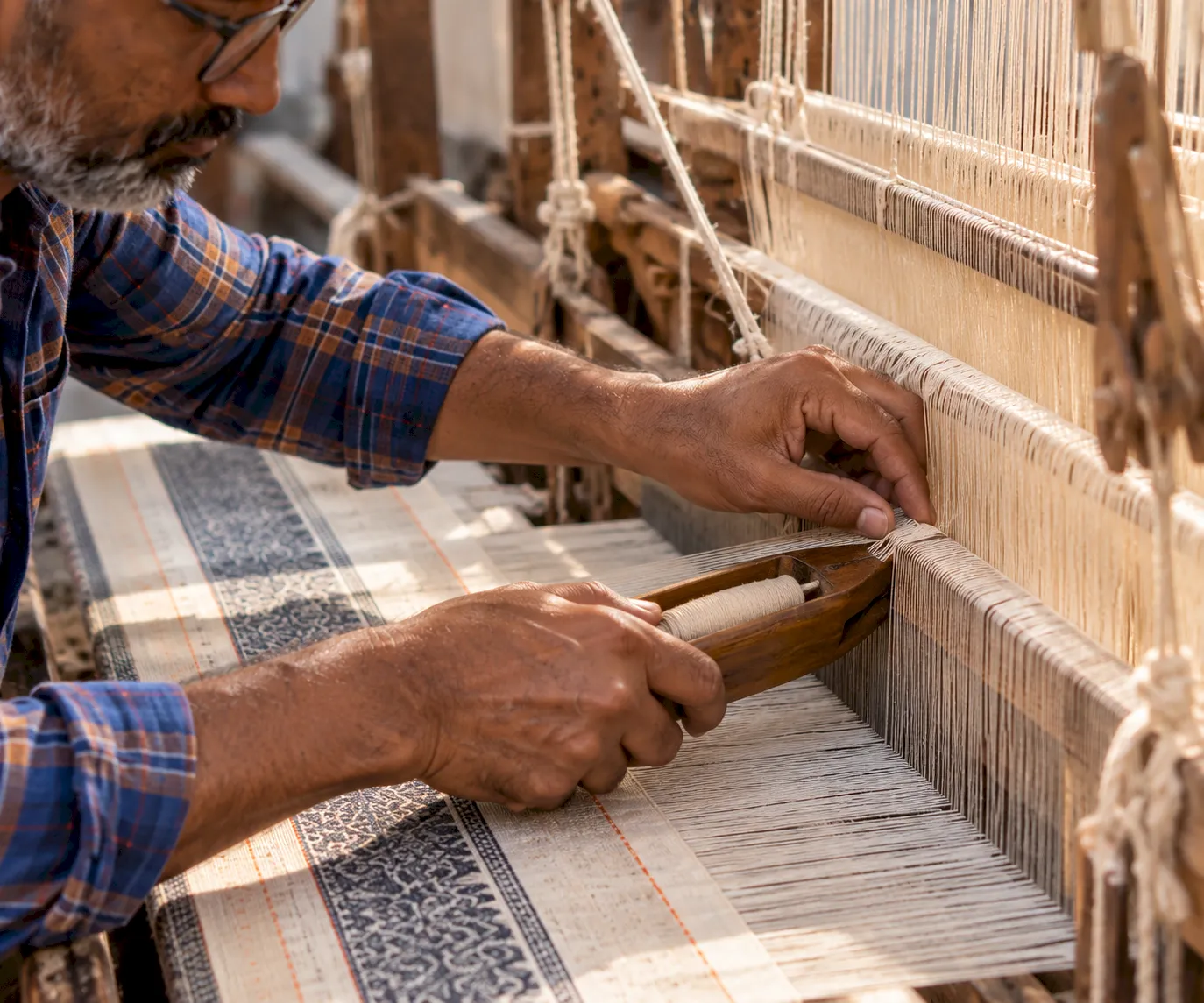
Every VANYRA ATELIER piece begins with people. Behind a shawl or scarf there are spinners, weavers, knitters and finishers across India, carrying techniques that have been handed down through generations. This article looks at what those hands actually do, stage by stage, and why the difference between hand work and machine work shows up in the way a piece feels, falls and lasts.
It is not a tour of a specific workshop and it does not put numbers on hours or years. It is an honest description of how hand-loomed textiles are made, and what a weaver is doing at each step, so that when you hold a finished piece you know what went into it.
Stage One: The Hands
Before there is cloth there is a skill. Hand weaving is a craft learned by doing, over a long time, usually beside someone more experienced. A weaver learns to read the thread: how taut it should be, how it will behave as the cloth builds up, when something is slightly off and needs correcting before it becomes a flaw.
The skills that go into a finished piece are several and distinct:
- Spinning: turning loose fibre into a continuous, even yarn.
- Weaving: interlacing warp and weft threads on a loom to make cloth.
- Knitting: looping yarn to make a stretchier fabric for sweaters and close-fitting pieces.
- Finishing: completing fringes, edges and embroidery by hand.
Each of these takes practice, and each shows in the result. When people say a piece has character, they are often describing the sum of these small decisions made by hand.
Stage Two: The Materials
The materials come first, and they set the ceiling on what the hands can achieve. We work with cashmere, merino wool and silk, chosen for their natural character. Each behaves differently on the loom:
- Cashmere is very fine and light, and it asks for a gentle touch and even tension.
- Merino wool is resilient and springy, which gives woven pieces body and structure while remaining soft against the skin.
- Silk is luminous and fluid, with a natural sheen that shows every irregularity, so it rewards careful, steady work.
You can read more about each fibre on our materials pages for cashmere, merino wool and silk. A weaver who knows the fibre adjusts how they work with it, which is one reason the same design can feel different in different materials.
Stage Three: Preparing the Loom
A loom does not simply start weaving. It has to be prepared, and this stage is easy to overlook because it happens before any cloth exists.
The lengthwise threads, known as the warp, are measured and arranged so that they are evenly spaced and evenly tensioned. They are then set up on the loom. This preparation is slow, and it is where much of the final quality is decided. Uneven tension in the warp shows up later as ripples or uneven edges that cannot be fixed once the cloth is woven.
Only when the warp is ready does the weaver begin to add the weft, the crosswise thread, one pass at a time.
Stage Four: The Process of Weaving
On a handloom the weaver's hands and feet do the work that a motor does on a powerloom. The weaver passes the weft thread through the warp, presses it into place, and repeats, thousands of times, watching the cloth as it grows.
What makes hand weaving different is control. The weaver feels the tension through the thread and adjusts it continuously. Where a machine repeats a fixed setting, a hand adapts. This tends to produce a cloth with more give, a softer hand feel and a more natural drape. It also means the cloth is slower to make, which is part of why hand-loomed pieces are considered special.
Small variations in a hand-woven fabric are a mark of how it was made, not a fault. Our article on handloom versus powerloom fabric explains this difference in more detail, and from fibre to finished shawl follows the same journey from another angle.
Stage Five: Knitting, Embroidery and Special Work
Not every piece is woven flat. Some are knitted, and some carry embroidery or other handwork. Knitting builds the fabric loop by loop, so it is stretchier and is chosen for sweaters and close-fitting pieces. Embroidery is stitched by hand after the cloth is made, adding a design that a loom alone could not produce.
Special work is also where personal commissions come in. If you would like a monogram, a portrait or a bespoke weave, that work is done by hand in the atelier, and you can start a request on our personalisation page.
Stage Six: The Finishing
When the weaving is finished, the piece is not done. Finishing is a set of separate steps, and they matter a great deal:
- Fringes and edges are finished entirely by hand, so they are neat and secure.
- Embroidery and any detail work is completed and checked.
- Inspection happens at several stages, not only at the end, so that problems are caught early.
- Pressing gives the piece a clean, finished appearance.
Two pieces made from identical fibre can feel completely different depending on how carefully they are finished. This is the stage where much of the difference between an ordinary piece and an exceptional one is decided.
Stage Seven: The Final Piece
When a piece has passed inspection it is pressed and prepared for its journey. Every finished piece is checked, then packed with care and sent on its way, whether that is across India or across the world.
That last stage is a promise more than a task. The piece has passed through many hands, and each of them cared about the result. If you are giving it as a present, our gift cards and gift wrapping options can help you present it well.
Why Hand Work Still Matters
It is fair to ask whether hand work is simply nostalgia. There are three honest reasons it is not.
It changes how the piece feels. Hand-controlled tension and hand-finished edges produce softer, more fluid cloth than a fixed machine setting usually does.
It changes how long the piece lasts. Careful finishing and secure edges mean a piece holds up better to years of wear.
It sustains skills and livelihoods. Hand weaving is a craft that survives only if it is worth practising. Choosing hand-loomed cloth supports the people who carry it forward. Our reflections on this are in sustainable luxury and natural fibres.
Frequently Asked Questions
Are your pieces really made by hand?
Our pieces are hand-loomed and hand-finished in India. Weaving, knitting and embroidery are carried out by hand, and fringes and edges are finished by hand before each piece is inspected.
Why does hand-loomed fabric sometimes have small irregularities?
Because a person controls the tension, not a fixed machine setting. Slight variations are a normal sign of hand weaving and are not defects in the piece.
How long does it take to make one piece?
It depends on the fibre, the design and the finishing, so we do not give a single number. Hand work is slower than machine production, and that is part of what you are paying for.
Can I ask for a monogram or a bespoke design?
Yes. Personalised and bespoke commissions are made by hand in the atelier. You can begin a request on our personalisation page and the team will respond with a quotation.
Where can I learn more about how hand weaving compares with machine weaving?
Our guide to handloom versus powerloom fabric compares the two, and our guide to how a handloomed shawl is made follows the process from fibre to finished piece.
See the Work Yourself
The best way to understand hand work is to hold it. Explore the VANYRA ATELIER collection, read about our craftsmanship, or begin a personalised commission.