From Fibre to Finished Shawl: How a Handloomed Shawl Is Made
Few things in a wardrobe are as quietly astonishing as a handloomed shawl. It appears effortless: a soft, drapable rectangle of cloth that folds into a bag and wraps around your shoulders. Behind it lies a long chain of decisions and skills, from the choice of fibre to the last twist of the fringe. Understanding how a handloomed shawl is made changes how you look at it, and it explains why such pieces cannot be produced quickly or cheaply.
This article follows a shawl through its stages: fibre, spinning, dyeing, warping, weaving, finishing and inspection. It describes the general process used in traditional Indian hand weaving, and where a stage can vary by region, fibre or workshop, it says so. Each shawl at VANYRA ATELIER is hand-loomed and hand-finished in India, and this is the tradition we work within. For the wider story, see the history of the Indian shawl and Inside the Atelier: A Weaver's Hands.
Stage 1: Choosing the Fibre
Everything depends on the raw material. A shawl can be woven from cashmere, merino wool, silk or blends of these, and each behaves differently. Cashmere is fine and soft, merino is resilient, and silk is smooth and strong. Our pages on cashmere, merino wool and silk describe each.
For cashmere, the quality of the fibre is judged by its fineness and its length. Finer fibre feels softer, and longer fibre makes stronger, smoother yarn. Poor fibre cannot be rescued by later skill. That is why serious makers spend the most attention at the very beginning. Read more in cashmere quality explained.
Stage 2: Preparing and Cleaning the Fibre
Raw fibre arrives with natural oils, dirt and vegetable matter. For cashmere, the fine undercoat must be separated from coarser guard hair, a process called dehairing. The fibre is then scoured, or washed, to remove impurities.
This is delicate work. Too much handling damages the fibre. Too little leaves impurities that show later as flaws in the yarn. Good preparation gives clean, lustrous fibre that spins well.
Stage 3: Carding and Spinning
Cleaned fibre is carded, meaning combed and aligned so that the fibres lie roughly parallel. It is then spun into yarn. In traditional shawl making, spinning is often done by hand, with a spindle or a spinning wheel, and it can produce extremely fine, even thread. Machine spinning is also used widely and can produce fine yarn.
The yarn's thickness, twist and evenness determine the fabric's character. A tighter twist gives a firmer, stronger yarn. A looser twist gives a softer, loftier one. Weavers choose the yarn to match the fabric they want, and different weights are used for warp and weft.
Stage 4: Dyeing
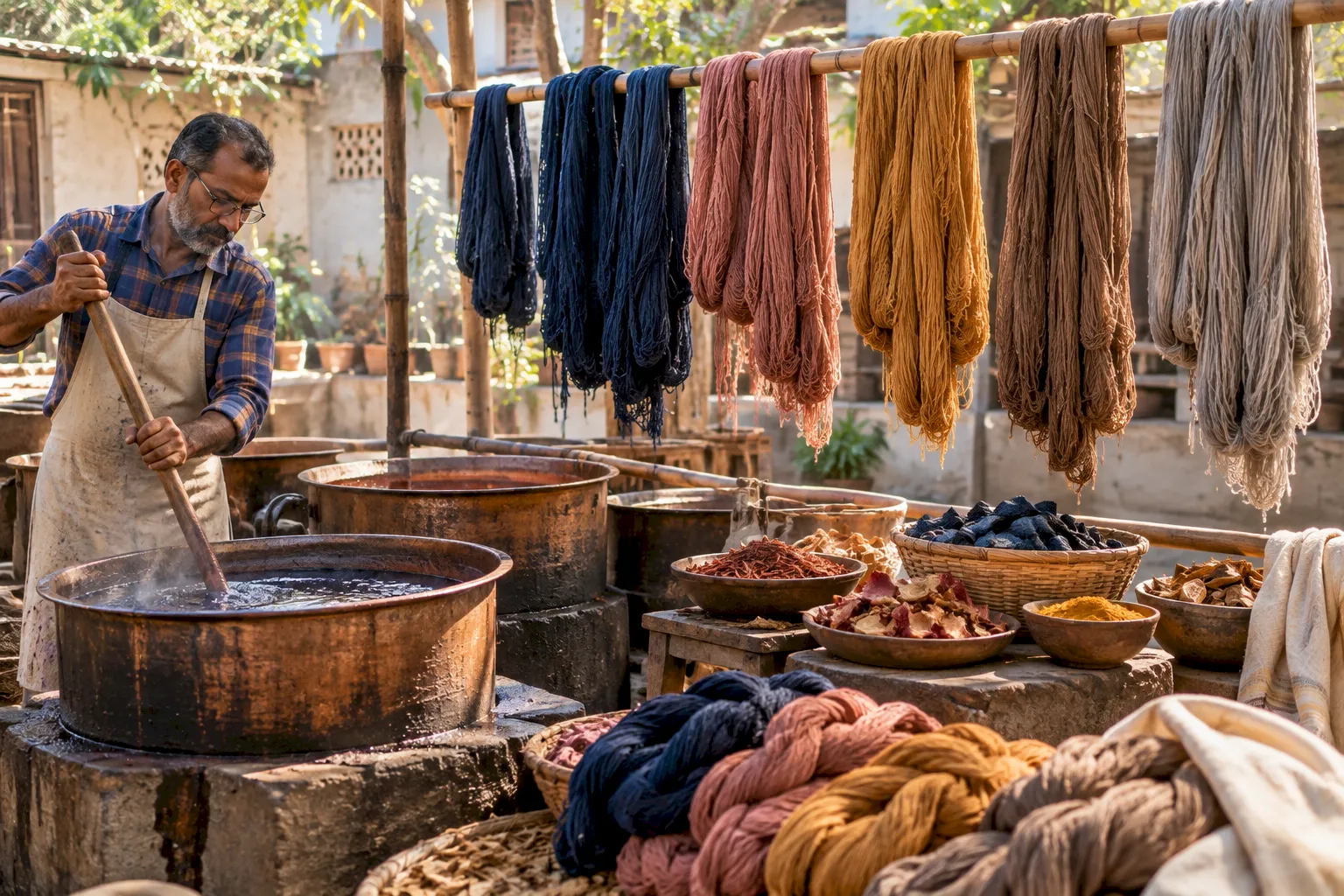
Yarn is dyed before weaving in many shawls. Dyeing is both technical and artistic. The dyer must achieve a colour that is even, rich and consistent across batches, and must do so without damaging fibres that are sensitive to heat and harsh chemicals.
Dyeing is done in controlled baths at moderate temperatures. Natural and synthetic dyes are both used in the craft, and responsible dyeing includes careful handling of water and effluent. Colours are checked against samples in natural light, since shades shift under artificial lighting. This is why a shawl's colour can look subtly different in a photograph, in a shop and at home in daylight. We discuss choosing colours in how to choose a shawl.
After dyeing, yarn is rinsed, dried and wound onto bobbins or cones, ready for the loom.
Stage 5: Warping and Setting Up the Loom
Before weaving can start, the loom must be prepared. This stage is invisible in the finished shawl, but it decides whether the weaving goes smoothly.
The warp is the set of threads that runs the length of the fabric. The weaver, or a specialist warper, measures and arranges hundreds or thousands of warp threads in the correct order and colour sequence, keeps them under even tension and winds them onto the loom's beam. Each thread is then passed through the heddles, which lift and lower groups of threads to form the weave, and through the reed, which keeps the threads evenly spaced and beats the weft into place.
Setting up a loom can take a long time, sometimes longer than the weaving of a single simple piece. An error at this stage, such as a crossed thread or uneven tension, will show in the fabric throughout.
Stage 6: Weaving
Weaving is the interlacing of warp and weft. On a handloom, the weaver sits at the loom and controls every movement.
1. Shedding. The weaver lifts some warp threads with pedals or levers, creating an opening called the shed.
2. Picking. The weaver passes the shuttle, carrying the weft thread, through the shed.
3. Beating. The weaver pulls the reed forward to beat the new weft thread firmly against the previous one.
4. Changing the shed. The weaver switches the pedals or levers to raise a different set of warp threads and repeats.
This sequence is repeated thousands of times. The weaver constantly adjusts the tension of the warp, the force of the beat and the rhythm of the shuttle. Fine yarn such as cashmere breaks easily, so experienced weavers work with a light, even touch. The result is a fabric with a soft, relaxed feel.
Different weaves produce different fabrics. Plain weave is simple and balanced. Twill has a diagonal line and more drape. More complex weaves and patterns take considerably more time and skill. Some traditional techniques, such as Kani weaving, build patterns using many small bobbins of coloured thread, which is extraordinarily slow. Our article on handloom vs powerloom explains how handloom weaving differs from machine weaving.
Weaving speed varies with the yarn, the width and the complexity of the design. It can take many hours for a simple piece and far longer for intricate work.
Stage 7: Removing the Cloth and Initial Inspection
When the piece is complete, it is cut from the loom. At this stage the fabric is called greige, meaning it has been woven but not yet finished. It looks and feels different from the final shawl: sometimes a little stiff, sometimes slightly uneven.
The greige cloth is inspected. Skilled inspectors check for broken threads, uneven weave, knots, stains or colour problems. Small faults can sometimes be mended by hand. Serious defects may lead to the piece being set aside.
Stage 8: Finishing
Finishing transforms the fabric into the soft, drapable cloth we recognise. The exact process depends on the fibre and the desired effect.
Washing
Woven cloth is washed gently in cool or lukewarm water. Washing removes spinning oils and residues, relaxes the fibres and allows the cloth to bloom, meaning it becomes softer and slightly fuller. Careful control of temperature and agitation matters, because too much of either can felt or shrink the fabric.
Drying and pressing
The cloth is dried flat or in a controlled environment and pressed to give it a smooth surface and correct dimensions.
Brushing and raising
Some shawls are lightly brushed to raise a soft nap on the surface. This gives a warm, velvety hand. Not every shawl is brushed.
Trimming and mending
Loose threads are trimmed, and any remaining small flaws are mended by hand.
Edges and fringes
Edges are completed and fringes are made. Fringes are created from the ends of the warp threads. They are twisted or knotted by hand, in groups, into neat tassels. This is slow and skilled work, and the quality of the fringe is one of the marks of a well-finished piece.
Stage 9: Final Inspection and Quality Control
Before a shawl is packed, it is checked again for size, colour consistency, weave regularity, edges, fringes and general finish. The piece is held to the light and examined closely on both sides. Only pieces that meet the standard go forward.
A clear quality-control process is one of the marks of a serious maker. If you want to know what a particular brand does, ask: who inspects, at what stages and against what standards?
Stage 10: Packing and Care Instructions
A finished shawl is folded, wrapped in breathable material and packed with care instructions. At VANYRA ATELIER, our standard instruction is dry clean only, and to store the piece folded in a breathable bag away from direct sunlight. Our guide on how to care for cashmere explains the routine in detail.
How Long Does It Take?
There is no single answer, because time depends on fibre, yarn fineness, width, weave and finish. What is true is that a handloomed shawl represents many stages, several skilled people and a substantial amount of time. A piece that seems inexpensive for a handwoven cashmere shawl should prompt questions about what corners were cut.
Why the Process Matters to You
Understanding the process helps you see what you are paying for and what to look for.
- The softness comes from fibre quality, careful spinning and gentle finishing.
- The drape comes from the yarn, the weave and the relaxed tension of hand weaving.
- The edges and fringes show the level of finishing.
- The longevity comes from all of these together.
- The individuality comes from the human hand.
When you see the Golden Peach pure cashmere shawl or the Forest Moss cashmere wrap, you are looking at the end of this chain of work. Learn more about our approach on our craftsmanship page.
Frequently Asked Questions
How is a handloomed shawl made?
It is made in stages: fibre selection and preparation, spinning, dyeing, warping, weaving on a handloom, finishing, and final inspection. Each stage involves skilled manual work.
How long does it take to weave a handloomed shawl?
It depends on the yarn, width and complexity. Simple pieces can take many hours, while intricate designs can take far longer. Preparing the loom also takes considerable time.
What is the difference between warp and weft?
The warp is the set of threads that runs lengthwise on the loom. The weft is the thread that crosses it. Weaving is the interlacing of the two.
Why are the fringes of a shawl done by hand?
Fringes are formed from the warp ends, and twisting or knotting them by hand gives a neat, secure finish. It takes time, and hand-finished fringes are a mark of careful work.
Why is handloomed cashmere so soft?
Softness comes from fine, long fibre, well-spun yarn, gentle handling on the loom and careful washing and finishing. Hand weaving applies less tension than high-speed machines, which suits delicate fibres.
See the Result
To see the work that goes into a piece, browse the VANYRA ATELIER collection, read our house story, or contact us if you would like to know more about how a particular piece was made.