History of the Indian Shawl: Pashmina, Kani and Kashmir Weaving
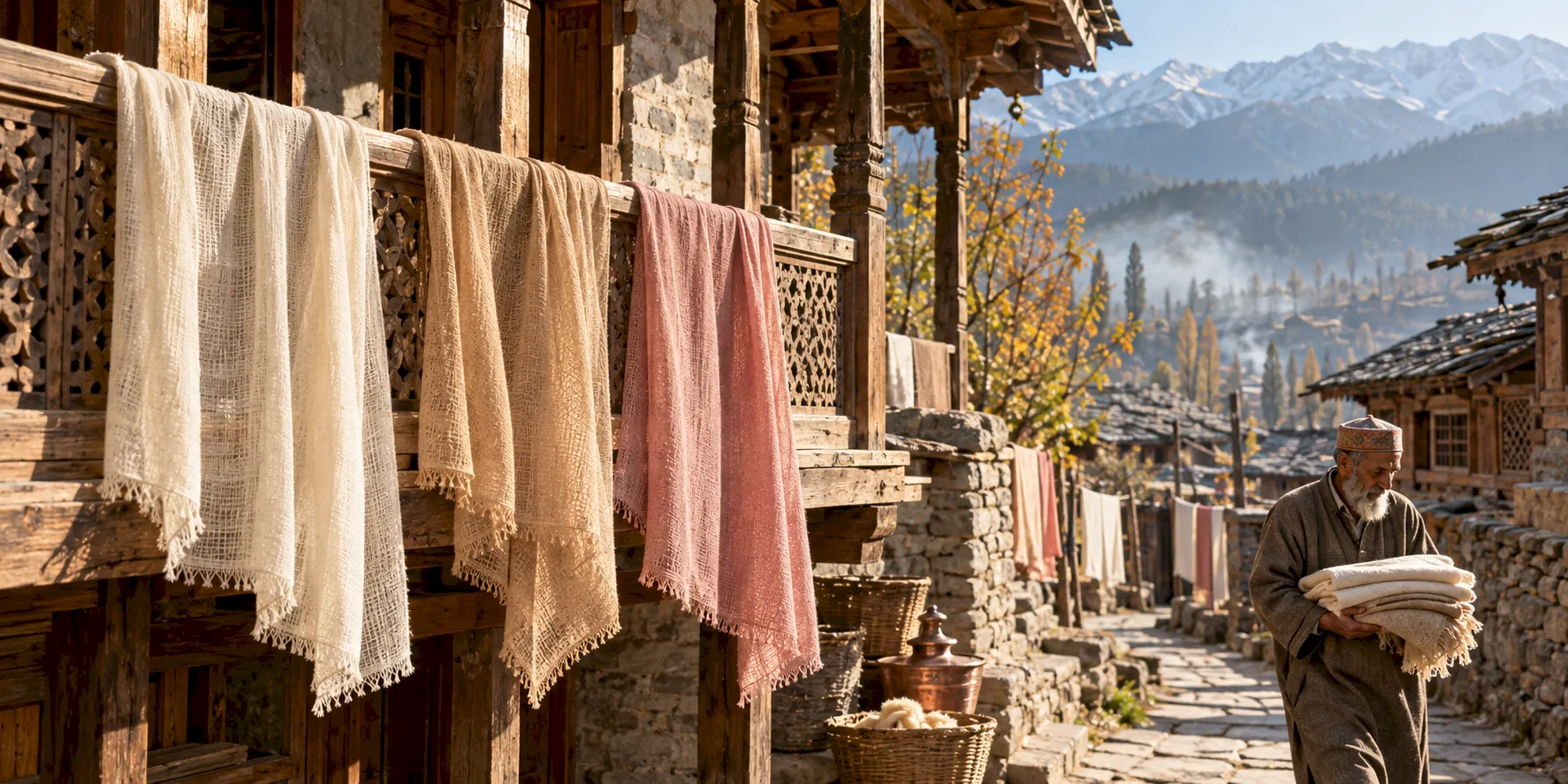
The history of the Indian shawl is a story of fibre, skill, status and exchange that stretches across many centuries. Few garments carry so much cultural weight. A shawl has been a daily necessity, a wedding gift, a mark of rank, a diplomatic present and, eventually, an object of European fashion. Understanding where shawls come from deepens the pleasure of wearing one, and it explains why the finest hand-loomed shawls are still valued so highly today.
This article follows the shawl from the high plateaus where the fibre is grown to the looms of Kashmir and beyond. It explains the difference between pashmina, cashmere and shawl, describes the famous Kani and embroidered traditions, and looks at how the Indian shawl travelled the world. It also clarifies where accounts are uncertain, because shawl history is rich with legend and not every popular story is well documented.
The Origins: Fibre From the High Plateaus
Every shawl begins with a fibre. The finest Indian shawls have traditionally been made from the soft undercoat of goats raised at very high altitude in the Himalayan region, in places such as Ladakh, where winters are extreme. The animals grow a dense, ultra-fine down beneath their coarse outer hair to survive temperatures far below freezing. That down is the raw material of pashmina and cashmere.
In Ladakh, herding communities, including the Changpa nomads, have long kept the goats often called Changthangi goats. The fine undercoat is combed by hand in spring as the animals begin to moult. It is a slow, careful process, and each goat yields only a small quantity of usable fibre. That scarcity is the origin of the fibre's value.
Pashmina and Cashmere: Same Thing or Not?
The words are often used interchangeably, and in everyday shopping they overlap, but they are not identical.
"Pashmina" derives from a Persian word associated with fine wool. In the traditional Kashmiri sense, it refers to the very fine fibre from high-altitude Himalayan goats and to the shawls handwoven from it. "Cashmere" is the broader English word, itself derived from the old spelling of Kashmir, for the fine undercoat of goats from several regions, including Mongolia and China as well as the Himalaya.
In modern retail, "pashmina" has also become a generic word for any large wrap-style scarf, sometimes made from blends or even viscose. That is why it is worth checking the composition label. Our guide on how to identify real cashmere explains what to check, and our material page on cashmere covers the fibre itself.
Kashmir and the Rise of the Shawl Industry
Kashmir became the great centre of fine shawl weaving. Over the centuries, weavers there developed techniques and designs that were admired across Asia and eventually Europe. Historical accounts credit various rulers and courts with encouraging the trade, and the industry grew into a major source of livelihood and export.
A shawl was rarely the work of one person. Spinners, often women working at home, spun the fibre into extraordinarily fine thread. Dyers coloured the yarn. Designers and pattern-makers prepared the motifs. Weavers set up the looms and wove. Finishers washed, trimmed and completed the piece. Each stage required skill, and the finest shawls could take months or even years to complete.
The Kani Tradition
Kani weaving is one of the most celebrated shawl techniques. Instead of a shuttle carrying a continuous weft thread across the whole width, weavers use small wooden bobbins, called kanis, each carrying a single colour and used only where that colour is needed in the pattern. The weaver follows a coded pattern guide, called a talim, which records the design as a sequence of instructions.
Because each colour area is built up bobbin by bobbin, a Kani shawl with an intricate pattern is extraordinarily slow to weave. A single piece can take a very long time, and the reward is a design that is woven into the fabric rather than printed or embroidered on top. The technique survives, and modern Kani shawls remain among the most prized textiles in India.
Embroidered Shawls
Alongside woven patterns, embroidery became a major tradition. Sozni embroidery, worked with fine needles in delicate stitches, decorates shawls with flowers, vines and paisley-like motifs. Other styles use bolder threadwork. Embroidery can cover a whole shawl or edge it in a narrow border. These pieces were, and are, treasured as wedding gifts and family heirlooms.
The Shawl at Court and in Ceremony
In many parts of India, shawls have long played roles beyond warmth. They were presented as honours, exchanged as gifts of respect, draped over guests and given to mark important moments. A khilat, or robe of honour, could include a shawl, and receiving one signalled recognition.
That ceremonial role continues. In Indian weddings and festivals, giving and receiving shawls remains a gesture of regard. We explore this further in our article on Indian wedding gift ideas.
How the Shawl Travelled the World
From the eighteenth century into the nineteenth, Kashmir shawls attracted growing attention in Europe. Travellers, traders and officials brought them home, and they became sought-after luxury items. European manufacturers began imitating the patterns on their own looms, and the teardrop or cone-shaped motif that had long featured in Kashmiri design became widely associated with the shawl and ultimately gave the pattern its common English name, paisley, after a Scottish town that produced imitations.
The European fashion for shawls had lasting consequences. It created a large export market for Kashmiri weavers and prompted many imitations, foreshadowing the labelling concerns of today. It also carried the Indian shawl into the imagination of the world as a symbol of luxury.
Change and Continuity in Modern Times
Changing markets, political upheaval and the rise of mechanised production reshaped the shawl industry over the twentieth century. Machine-made imitations, sometimes sold under names that implied Kashmiri origin, competed on price. In response, India has introduced measures to protect authentic craft, including geographical indication recognition for certain traditional products, which is one way of helping buyers identify origin. Check the current details of any mark before relying on it.
Despite the pressures, hand weaving and hand embroidery continue. Skilled weavers, embroiderers and finishers keep the tradition alive, often across families and generations, and there is renewed interest among buyers who value provenance and slow craft. Our piece on handloom vs powerloom explains how to tell handwoven work from machine-made.
What the Shawl Means Today
Today the shawl is at once traditional and modern. It sits over a saree or lehenga at a winter wedding, over tailoring in an air-conditioned office and over a plain coat on a cold flight. It has no season and no single correct use. For ideas on wearing one, see our guide on how to wear a shawl, and for choosing one, see how to choose a shawl.
At VANYRA ATELIER, we work within this heritage. Each piece is hand-loomed and hand-finished in India, using techniques passed through generations of craftspeople. Learn more on our craftsmanship page and our house page, or see how a piece takes shape in how a handloomed shawl is made.
Timeline at a Glance
- High plateaus of the Himalaya: herding communities raise goats whose fine undercoat becomes pashmina and cashmere fibre.
- Kashmir: weaving and embroidery traditions develop into a celebrated shawl industry, including Kani weaving and Sozni embroidery.
- Courts and ceremony: shawls become gifts of honour, marks of status and treasured wedding presents.
- Eighteenth and nineteenth centuries: Kashmir shawls become fashionable in Europe, and their motifs are copied widely.
- Twentieth century: mechanisation and imitation challenge traditional weaving; efforts to protect authentic craft emerge.
- Today: hand-loomed shawls are valued by buyers who care about provenance, quality and craft.
Frequently Asked Questions
Where does the Indian shawl come from?
Some of the most famous Indian shawls come from Kashmir, where weaving and embroidery traditions developed over centuries using the fine undercoat of Himalayan goats. Other regions of India have their own shawl and wrap traditions too.
What is the difference between pashmina and cashmere?
Cashmere is the general term for the fine undercoat of goats. Pashmina traditionally refers to the very fine fibre and shawls of the Himalayan region, especially Kashmir. In modern retail the word is sometimes used loosely for any large wrap, so check the label.
What is Kani weaving?
Kani weaving is a technique in which small bobbins, each carrying one colour, are used to weave patterns directly into the cloth following a coded guide. It is very slow and produces intricate designs.
Why is paisley associated with Kashmir shawls?
The teardrop or cone-shaped motif was long used in Kashmiri shawl design. When European mills copied it in the nineteenth century, one Scottish town became so associated with the pattern that its name became the English word for it.
Are hand-loomed shawls still made today?
Yes. Skilled weavers, embroiderers and finishers continue to produce hand-loomed and hand-embroidered shawls across India, and many buyers seek them for their quality and cultural value.
Wear a Piece of the Tradition
To explore shawls made in this spirit, browse the VANYRA ATELIER collection, including the Golden Peach pure cashmere shawl and the Forest Moss cashmere wrap, or contact us with any question about how our pieces are made.