The Language of Cashmere
Shopping for cashmere can feel like learning a second language. Labels talk about microns and plies. Sellers use words like pashmina, grade A and hand feel as though everyone already knows what they mean. Reviews mention pilling. Guides mention combing and dehairing. None of it is difficult, but almost nobody explains it in one place.
This is that place. Below is a plain-English glossary of the language of cashmere, grouped by where you will meet the words: the fibre itself, how it is made into cloth, how the finished piece behaves, and how it is cared for. At the end there is a short guide to reading a label, and answers to the questions we hear most often.
Words About the Fibre
Cashmere
Cashmere is the fine, soft undercoat of the cashmere goat. The goats grow this insulating layer beneath their coarser outer hair to survive very cold winters in the high, dry regions of Central Asia and the Himalayas. In spring, as the weather warms, the undercoat is shed naturally. It is gathered by combing, which is why fine cashmere is often described as combed rather than shorn.
The fibre is prized because it is very fine, very light and warm for its weight. It is the same reason the goats grow it: a thin, soft layer that traps warmth without bulk.
Micron
A micron is one millionth of a metre, and it is the unit used to describe how thick a single fibre is. For cashmere, a lower micron number means a finer fibre. Finer fibres feel softer against the skin and drape more fluidly. As a general guide, fibres in the finest range are noticeably softer than coarser ones, and a very fine fibre feels different from a merely acceptable one within seconds of touching it.
Micron is only one part of quality. It tells you about thickness, not about length or how the yarn was spun, so it should be read alongside the other terms in this glossary. Our guide to cashmere quality, micron, grade and fibre length goes into this in depth.
Fibre length
Longer fibres are generally better. When a yarn is spun from long fibres there are fewer loose ends, so the surface stays smoother and the piece tends to pill less. Short fibres poke out of the yarn more easily, and those loose ends are what tangle into small bobbles with wear.
Guard hair
Guard hair is the coarser outer hair that grows over the soft undercoat. It is not desirable in the finished fabric, because it feels scratchy and does not have the softness of the undercoat. After combing, the fibre goes through dehairing, in which guard hair is separated out as thoroughly as possible. How well this is done makes a real difference to how a piece feels.
Pashmina
Pashmina is a word people often use as a synonym for any shawl, but it has a more specific meaning. It refers to a very fine form of cashmere, traditionally from goats in the high-altitude Himalayan region, that is spun and woven by hand into light, warm shawls. In everyday shop language the word has been stretched to cover almost any wrap, including many made from blends or other fibres, so it is worth asking what a pashmina is actually made of. Our history of the Indian shawl, Pashmina, Kani and Kashmir weaving, tells the longer story.
Words About How Cashmere Is Made
Combing and dehairing
These are the two earliest stages. Combing gathers the undercoat from the goat. Dehairing removes the coarse guard hair from the gathered fibre. Both are careful, labour-intensive steps, and both influence the softness of what follows.
Spinning and ply
Spinning twists loose fibres into a continuous yarn. Ply describes how many of those spun strands are twisted together to make the final yarn. A single-ply yarn is one strand and tends to be lighter and softer. A two-ply yarn twists two strands together and is generally more durable and more even. Neither is better in every case: it is a trade-off between lightness and robustness, and it depends on what the piece is meant to do.
Weaving and knitting
Cashmere is turned into cloth in two main ways. In weaving, threads cross each other on a loom at right angles, producing a stable fabric that is ideal for shawls, wraps and scarves. In knitting, a single yarn is looped through itself, producing a stretchier fabric that suits sweaters and close-fitting pieces. The construction shapes how a piece feels and behaves. You can read more about how hand weaving differs from machine weaving in handloom versus powerloom fabric.
Handloom
A handloom is a loom operated by the weaver's hands and feet rather than by an electric motor. A hand-loomed piece is woven more slowly and with more human control over the tension of the threads. Small irregularities in a hand-loomed cloth are not defects. They are a sign of how it was made.
Twill, plain weave and other weaves
The weave is the pattern in which warp and weft threads interlace. A plain weave is the simplest, with threads crossing over and under one another in alternation. A twill has a diagonal pattern and usually a softer, more fluid drape. The choice of weave changes how a shawl looks and falls, even when the fibre is identical.
Finishing
Finishing covers everything after the cloth is woven or knitted: washing, brushing, trimming, hand-finishing fringes and edges, pressing and inspection. Good finishing is a large part of why two pieces made from the same fibre can feel very different.
Words About How Cashmere Behaves
Hand feel
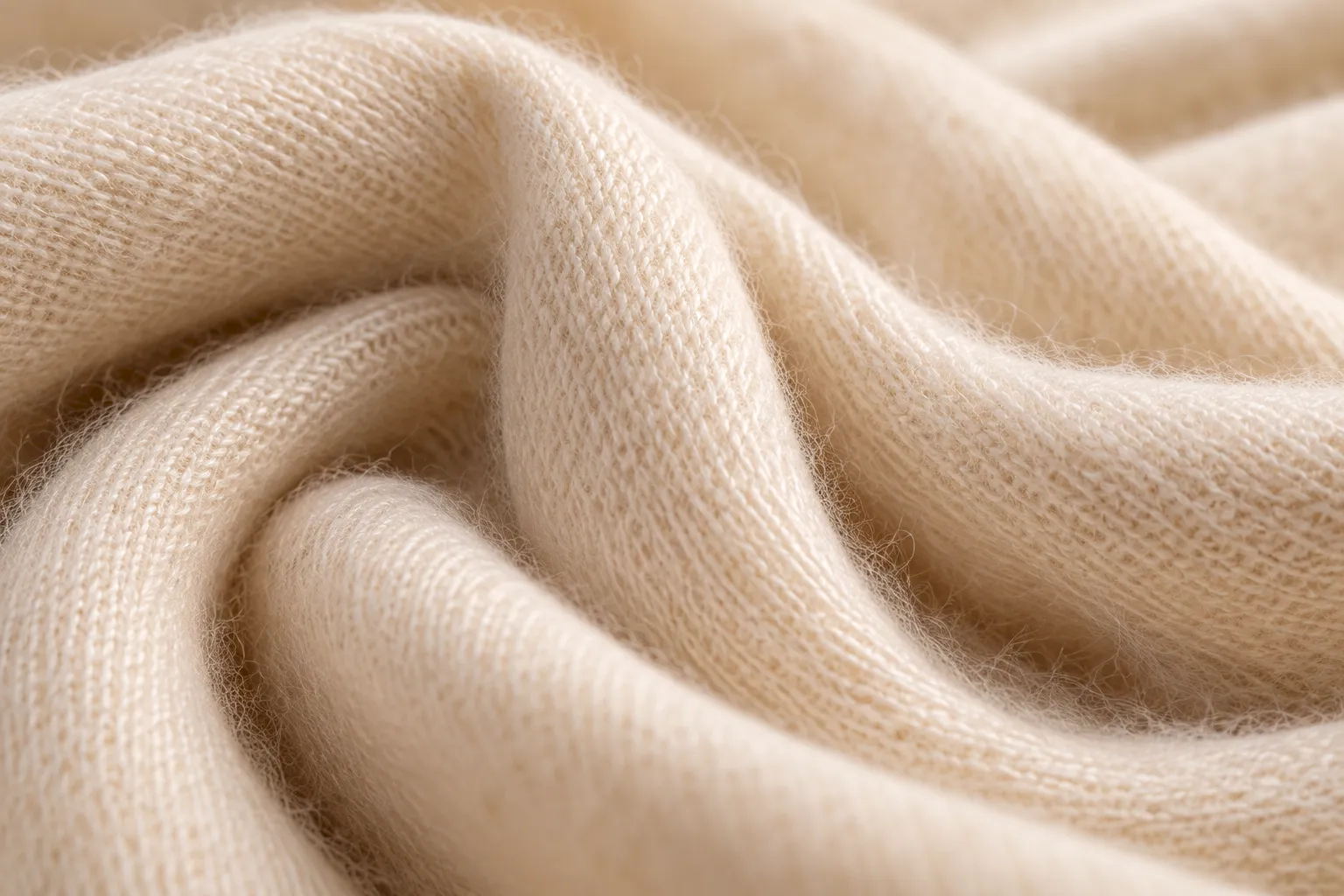
Hand feel is the sensory impression of a fabric when you touch it: how soft, smooth, dense or airy it seems. It is subjective, but it is the single most useful test you can perform in person. Rub the fabric between your fingers. It should feel soft and slightly cool at first touch, and it should not feel coarse or prickly.
Drape
Drape describes how a fabric falls and moves. A shawl with good drape falls in soft folds and follows the body. A stiff fabric holds its own shape and stands away. Drape depends on the fineness of the fibre, the yarn, the weave and the finishing.
Loft
Loft is the airy, springy quality that lets a fabric trap warmth. A lofty piece feels light but warm. Fabrics that are pressed flat or compressed lose loft and feel thinner.
Pilling
Pilling is the formation of tiny bobbles on the surface of a fabric, usually where there is friction, such as under the arms or where a bag strap rests. It is normal for natural fibres, including good cashmere, and is not a sign that a piece is fake or poor. It does tend to be more pronounced in pieces made from shorter fibres. Our guide, why does cashmere pill, explains the causes and how to remove pills safely.
Blooming
Some cashmere pieces are gently brushed during finishing, which raises a soft halo of fibre on the surface. Over the first few wears this halo settles and the fabric can look slightly different from when it was new. This is a normal stage in the life of a piece.
Shedding
New cashmere sometimes sheds a few loose fibres in the first weeks. This is usually just excess fibre working its way out and it settles quickly. Constant heavy shedding over a long time can suggest a loosely spun yarn.
Words on the Label
Percentage of fibre
The label should state how much of the fabric is cashmere and what the rest is. Pure or one-hundred-percent cashmere means the fabric is made of that fibre alone. A blend combines cashmere with something else, such as silk or wool, which can be a good choice when it is done deliberately for drape or durability, but the percentage should be clear.
Care instructions
Always follow the care label on the piece you own. As a general rule, cashmere prefers gentle treatment: minimal washing, no heat, no wringing, and drying flat. Our own pieces are labelled dry clean only, so guidance for hand washing elsewhere is for other items whose labels allow it. Our full guide is how to care for cashmere.
Made in
The place of manufacture tells you where the cloth was woven or knitted and finished, which is not always the place the fibre came from. Fibre and finishing can come from different places, so it is fair to ask.
Putting the Language to Use
The next time you pick up a piece of cashmere, run through a short mental checklist:
- Feel: is it soft and smooth between the fingers, without prickle?
- Weight: does it feel light for the warmth it promises?
- Drape: does it fall in soft folds when you hold it up?
- Surface: is it even, with no obvious loose ends or rough patches?
- Label: is the fibre content stated clearly, along with care instructions?
If you want to test whether a piece is genuine, our guide to identifying real cashmere lists practical checks you can do before you buy. And if you are choosing between fibres, cashmere versus merino wool sets out the differences clearly.
Frequently Asked Questions
What is the difference between cashmere and pashmina?
Pashmina is a very fine form of cashmere from the high Himalayas that is traditionally spun and woven by hand. All pashmina is cashmere, but not everything sold as pashmina is genuine. Always check the fibre content on the label.
What does micron mean for cashmere?
Micron measures the thickness of a single fibre. A lower number means a finer fibre, which generally feels softer and drapes better. It should be read alongside fibre length and how the yarn was spun.
Is pilling a sign of poor quality?
Not on its own. Pilling happens to almost all natural fibres where there is friction. It is more likely with shorter fibres, but even excellent cashmere can pill a little. It can be removed gently, and it usually reduces with time.
What does two-ply mean?
Two-ply means two spun strands have been twisted together to make the yarn. It usually makes the yarn more durable and even than a single strand, at some cost to lightness.
What is hand feel?
Hand feel is how a fabric feels when you touch it. It is subjective, but it is the quickest way to judge softness and finish when you are shopping in person.
Does 100 percent cashmere mean the best quality?
It means the fabric is made only of cashmere, but quality also depends on fibre fineness, length, spinning, weaving and finishing. Two pieces that are both pure cashmere can feel very different.
Continue Exploring
Once you know the words, the pieces speak for themselves. Explore cashmere at VANYRA ATELIER, browse the collection, or read more about how our pieces are made in from fibre to finished shawl.